 To all the soon-to-be teachers at ULV.
 This book was created and published on StoryJumper™
©2010 StoryJumper, Inc. All rights reserved.
Publish your own children's book:
www.storyjumper.com


Hello, my name is Brian the
Brain and this is my dog
Toby.We're here today to
teach you some important
scientific terms and how
you can relate them to some
cool experiments.




 Volume: length x width x height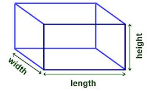
 Mass: is measured in kilograms or grams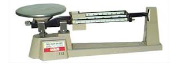
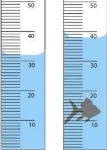
 Volume Displacement: A solid
 displaces a matching volume of
water when the solid is placed in water.

Physical Change- changes affecting the form of a
chemical substance, but not its chemical
composition
Chemical Change- is any change that results in the
formation of new chemical substances.

Chemical Property- a property or behavior of a
substance when it undergoes a chemical change
or reaction.
Physical Property- The measurement of a physical
property may change the arrangement of matter in a
sample, but not the structure of its molecules.
Ex. mass, density, color, boiling point, temperature, and volume.
Mixture- a substance made by mixing other
substances together.
Density is the amount of matter in within a certain volume.
Density can be found by using the equation:
Mass/ Volume

 Solution-a liquid mixture in which the minor component(the solute)
 is uniformly distributed within the major component (the solvent)
 Suspension- a mixture in which small particles of a substance
are dispersed through out a gas or a liquid.
Qualitative-Deals with descriptions.Data can be observed but not measured.
Colors, textures, smells, tastes, appearance.
Quantitative- Deals with numbers. Data which can be measured.
Length, height, area, volume, weight, speed, time, temperature, humidity,
sound levels, cost, members
Now that all that
vocabulary is out of the
way...
Let's get started!!!!!
Let's look at some examples of finding density.
Mass/ Volume
1) Mineral #1: Mass: 16.5g Volume: 10ml
16.5g / 10ml= 1.65 g/ml
2) Mineral #2: Mass: 14.5 Volume: 4ml
14.5g / 4ml= 3.625 g/ml
3)Electric Circut:
Mass: 13.5g Volume: 2.5 x 1 x 1.375= 3.4375cm3
13.5g x 3.4375cm3= 3.927 g/cm3
4) Square Magnet
Mass: 100.5g Volume: .875 x .875 x 1.875= 1.4355cm3
100.5g x 1.4355cm3= 70.01 g/cm3
5)Round Magnets: Mass: 68g Volume: 14ml
68g x 14ml= 4.857 g/ml
6)Block #1: Mass: 21.5g Volume: 24ml
21.5g x 24ml= 0.895 g/ml
7)Block #2:
Mass: 15.5g Volume: 0.75 x 1.75 x 0.75= 0.98cm3
15.5g x 0.98cm3= 15.75 g/cm3
8)Block #3
Mass: 70g Volume: 3.125 x 0.875 x1.75= 4.785 cm3
70g x 4.785cm3= 14.629 g/cm3
Now that we've learned how to find density by
using the equation....
Mass/ Volume
Now it's time to do some cool
science experiments!!!


 For our next two experiment, we need
to head to the kitchen for all of our
materials.
 Food!!!



For our first
experiment we'll
need:
safety goggles
zipper bags
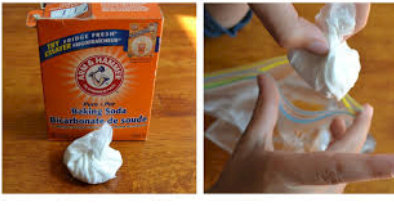
baking soda
vinegar

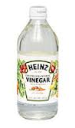


For this experiment, you will place in a zip-lock
bag 1 teaspoon of baking soda into 3-oz of
vinegar.
You've previewed 14 of 22 pages.
To read more:
Click Sign Up (Free)- Full access to our public library
- Save favorite books
- Interact with authors


- < BEGINNING
- END >
-
DOWNLOAD
-
LIKE(9)
-
COMMENT()
-
SHARE
-
SAVE
-
BUY THIS BOOK
(from $4.39+) -
BUY THIS BOOK
(from $4.39+) - DOWNLOAD
- LIKE (9)
- COMMENT ()
- SHARE
- SAVE
- Report
-
BUY
-
LIKE(9)
-
COMMENT()
-
SHARE
- Excessive Violence
- Harassment
- Offensive Pictures
- Spelling & Grammar Errors
- Unfinished
- Other Problem





COMMENTS
Click 'X' to report any negative comments. Thanks!