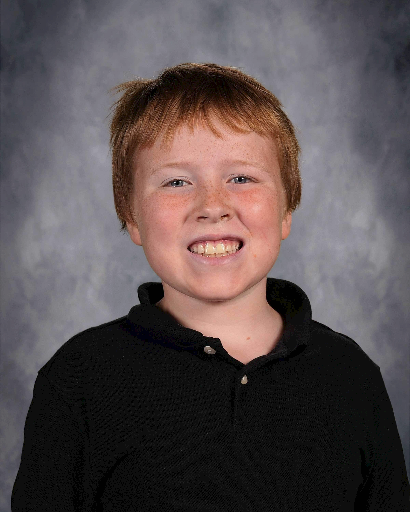
on his tenth birthday
From Grandpa Jamieson

Timequake!
Part I
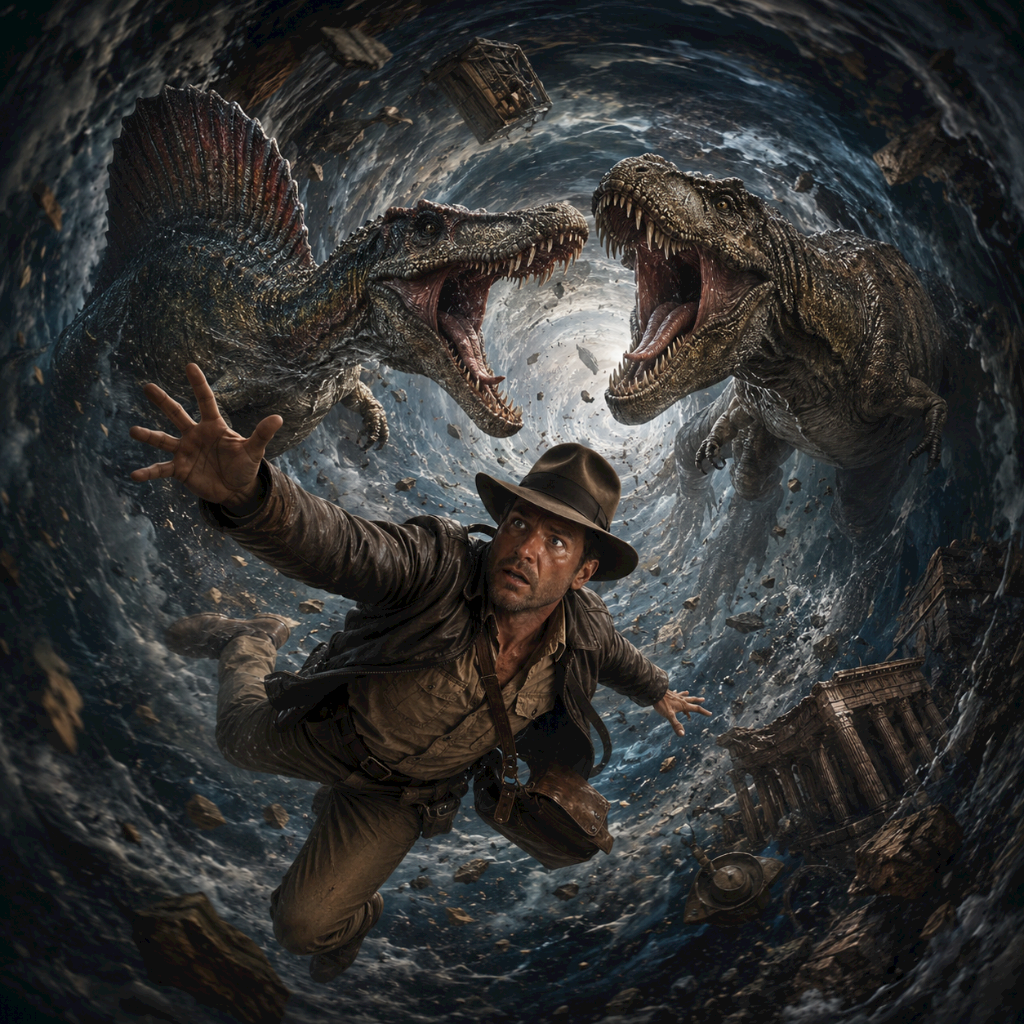
Timequake!
Part I
Introduction
I know that you will not believe what I am about to tell you, but I can assure you that it is true.
Here it is: I am from the future and I am writing this to warn you about the dangers of time travel.
There, I have said it! It is against the law - what we call the Prime Directive - for me to do this, but I think that it is important that I warn you, not only for your sake but for mine as well, and for the future of the world.
Chapter 1: Flunkin' Duncan
In order for you to understand what I am talking about, we should probably go back to the beginning. For me, this is ancient history, but for you way back there in the 21st century, it is still well into your future.
There was a guy named Duncan Fairchild who unleashed the technology that made time travel possible. He was born in Pawtucket, Rhode Island, on November 6, 2147. Today - my today, not yours - we celebrate his birth on what we call Flunkin' Duncan Day.
You are probably wondering why our great hero is called Flunkin' Duncan. Well, that is what his classmates called him in school. You see, Duncan was a genius, but he was bored in school by the slow pace of learning. After a while, he just tuned it out and it showed in his schoolwork. The thing is, though, that he simply did not care. He was interested in just one thing: Time travel. He read all of the time travel books he could find and watched all of the time travel movies that were available. They filled his time and they filled his head with dreams that no one else knew about. To the rest of the world, he was just another slow learner.
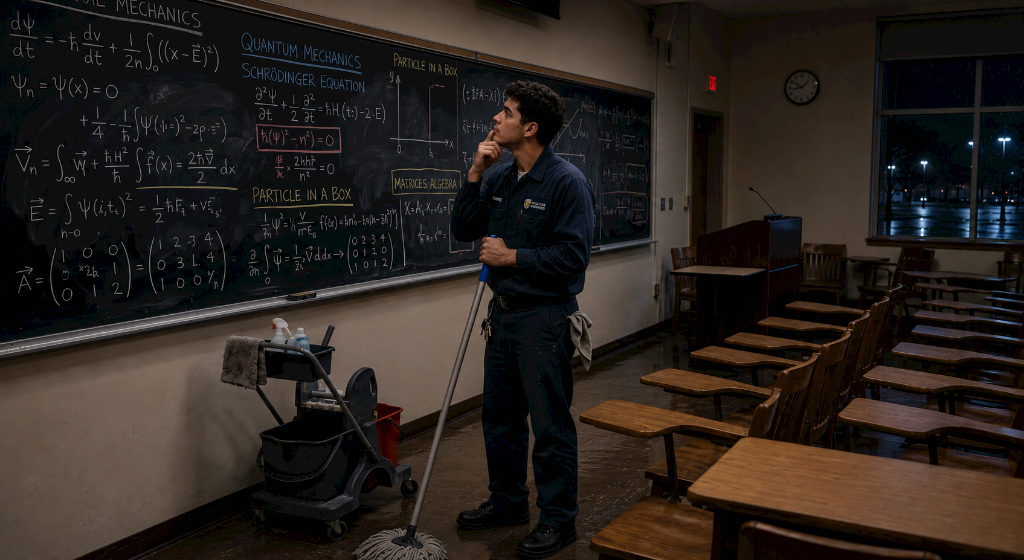
Duncan graduated from high school, but just by the skin of his teeth, as people used to say back in your time. He had trouble finding a job because of his dismal academic record, but he finally landed one as a night janitor at Third Millennium University. And, as luck would have it, he was assigned to clean the classrooms in the Nuclear Physics Department. That's where he first encountered the elusive tachyon particle that would soon revolutionize the world and transform the theoretical spacetime continuum into a real-world expressway to the past. And it all began when one of the professors left an unsolved equation on the chalkboard.
Duncan strolled into the classroom with his mop and bucket and began to mop the floor. When he was done with that, he noticed that the chalkboard also needed cleaning, but there on the board, in very large letters, was a message intended for him: DO NOT ERASE.
Intrigued, Duncan looked at the equation and suddenly felt a flash of insight. His brain had solved the equation subconsciously and then presented it to his conscious mind as a fully formed thought. He intuitively understood the implications of the equation. Those elusive faster-than-light tachyons could be the secret ingredient that would unlock time travel!
Duncan scribbled the solution onto the chalkboard and then nonchalantly moved on to the next classroom. The next morning, the entire department was abuzz. The professor was searching for the genius who had solved his equation. Was it one of his colleagues, a distinguished professor, perhaps? They all said no. No one would dare to take credit for someone else's work, work that was far beyond their own limited understanding. Was it a student, then, an undiscovered genius wandering the halls every day right under his nose? Nope. No one was willing to take credit for that brilliant solution, but there it remained, right up there on the chalkboard. The professor was stumped.
The next morning, Duncan woke up and poured himself a bowl of corn flakes. He carried it into the living room, sat down in his easy chair, grabbed the TV remote, and tuned in the local news channel.
"The Nuclear Physics Department at Third Millennium University is offering a one-million-dollar reward to the person who solved this equation on the chalkboard of one of its classrooms," said a reporter, displaying the unsolved equation on the screen. "All you have to do is solve it again, tell us how you did it, and explain how you managed to get into the classroom in the middle of the night."
Duncan could hardly believe what he was hearing. A million dollars, just for solving a simple equation! It was crazy. But, boy-oh-boy, he sure could use that money. He wrote down the phone number from the TV screen and then finished his breakfast. After he shaved and showered, he wrote down his solution to the equation, all from memory. Then he called the number.
"Where do I send the solution?" he asked the person who answered the phone. She gave him the address and asked if he could bring it with him in person. "OK," he said. "I'll bring it into work tonight."
"What?" replied the woman on the phone, "You work here? I thought that we had already asked everyone, professors and students alike. You really work here?"
"Yes, ma'am," answered Duncan, " My name is Duncan Fairchild and I'm the night janitor."
There was no response for almost a minute and then Duncan said, "Are you still there?"
"Uh, yeah, sure," she said. "I'm still here. But aren't you the guy they call Flunkin' Duncan?"
"Oh, my goodness," replied Duncan, "are they still calling me that? I thought I left that behind when I graduated from high school."
"Apparently not," replied the woman rather coldly, who then hung up the phone, thinking that he must be kidding about having solved the equation.
"Well, that was pretty rude," Duncan mumbled to himself. Nevertheless, he hopped on his bicycle and rode toward the campus, dreaming about what he might be able to do with all of that glorious cash.
Arriving at campus, Duncan went directly to the Nuclear Physics building and, with a big smile on his face, asked to see whoever was in charge of the one-million-dollar reward. He was told to have a seat and that he would be called in a few minutes. After 45 minutes, he had still not been called and was getting - oh, gosh, what was that word you used in the 21st century? Antsy? Yeah, that's it, he was getting pretty antsy. Like he had ants in his pants, I guess.
A few minutes later, a campus police officer walked into the room. The receptionist pointed to Duncan and the
officer approached him. "Are you Duncan Fairchild?"
"Yes," replied Duncan and he was arrested on the spot. When Duncan asked what he was being charged with, the officer told him that it was attempted fraud. "We believe that you did not solve that equation at all. We think that someone else did and that you simply copied it off the chalkboard. Now you are trying to claim the reward using someone else's work."
"Why do you think that?" asked Duncan.
"We've looked at your academic record," replied the
officer, "and, to put it bluntly, it's nothing to brag about. You are not smart enough to have solved that equation."
Eventually, the charges were dropped when Duncan demonstrated that he actually understood what the equation was all about and he was given the reward. Even better, he was given a professorship at Third Millennium University and, several years later, was installed as the head of the new Time Travel department. Finally, on November 6, 2197, Duncan Fairchild's 50th birthday, he became the world's first time traveler.
Chapter 2: Time Travel Basics
In the early days, time travel was rough. A person would receive a controlled dose of tachyons by injection, which would cause what became known as a "time bubble" to form around him. This allowed him to remain in his own time but to travel within the bubble to other locations on the spacetime continuum. The experience was quite unsettling, though, as the traveler appeared to be tumbling through a whirling vortex. It was like being sucked up into a tornado and tossed about with no control whatsoever. Few people had the stomach for it.
Over time, the injections gave way to oral methods like tachyon coffee and tachyon gummies. This became possible when a method was discovered to encase the tachyons in a material that allowed them to survive their trip through the digestive tract.
Even today - again, my today, not yours - certain purists and adventurers travel this way, but the development of timeships made the experience more civilized. These magnificent vessels make constant adjustments to smooth out the churning of a trip through the vortex. Most time travelers today cruise through time blissfully unaware that there is a vortex.
As with most new technologies, problems began to appear and had to be resolved. Most were fairly minor, but some were pretty serious. Most concerning, perhaps, was the discovery of ripples or tremors in the spacetime continuum. These roll forward in time, from an altered past into the future, and it is not clear even today how far they actually go.
Most of these ripples are fairly insignificant, according to the scientists who study them. We have experienced a few, though, that were quite massive, when great changes were inflicted upon the spacetime continuum. These massive disruptions are called timequakes.
It is not always immediately obvious to the person who triggers a timequake that he has in fact done so. It can come as quite a shock when he returns to his own time, only to discover that it has been changed. Was he responsible or was it someone else's fault?
A good example of this particular phenomenon is what has become known as the Post-Chicxulub Timequake. It was a doozy! Since ripples, tremors, and timequakes roll through time from the past to the future, it is not possible to attribute them to any particular time except for their point of origination. This point is called the temporal epicenter.
Once the word got out that it was possible to slip the surly bonds of time, a rogue's gallery of adventurers came forth to do just that. Some were in it for a fast buck, traveling back in time for the sole purpose of placing bets on sporting events or buying stock in companies that they knew would pay off handsomely. Others went back to meet their ancestors or to resolve historical mysteries.
Some wanted to bring back extinct flora and fauna. Private investigators sought to solve crimes by visiting the scene of a crime as it unfolded or even to prevent the crime in the first place.
Diplomats who blundered their way into wars tried to retrace their steps, hoping to do better with their second, third, or fourth efforts. Some even tried to right earlier historical wrongs or to introduce new technologies decades or even centuries before their time. These efforts produced mixed results, not all of them good. Alarmed by these events and fearful of the timequakes that were reverberating through the spacetime continuum, the authorities banned time travel completely. The penalties for violating the ban were severe and the ban remained in place for almost a century. There was the occasional violation, of course, but for the most part the ban was respected.
The ban was, nevertheless, controversial. What right, many asked, did the authorities of one era have to impose their will on the people of another era? It was a good legal question, but as a practical matter what was the alternative? Whatever was decided - or not decided - would impact the people of all eras, past, present, and future. And everyone knew it.
Chapter 3: Opportunity Knox
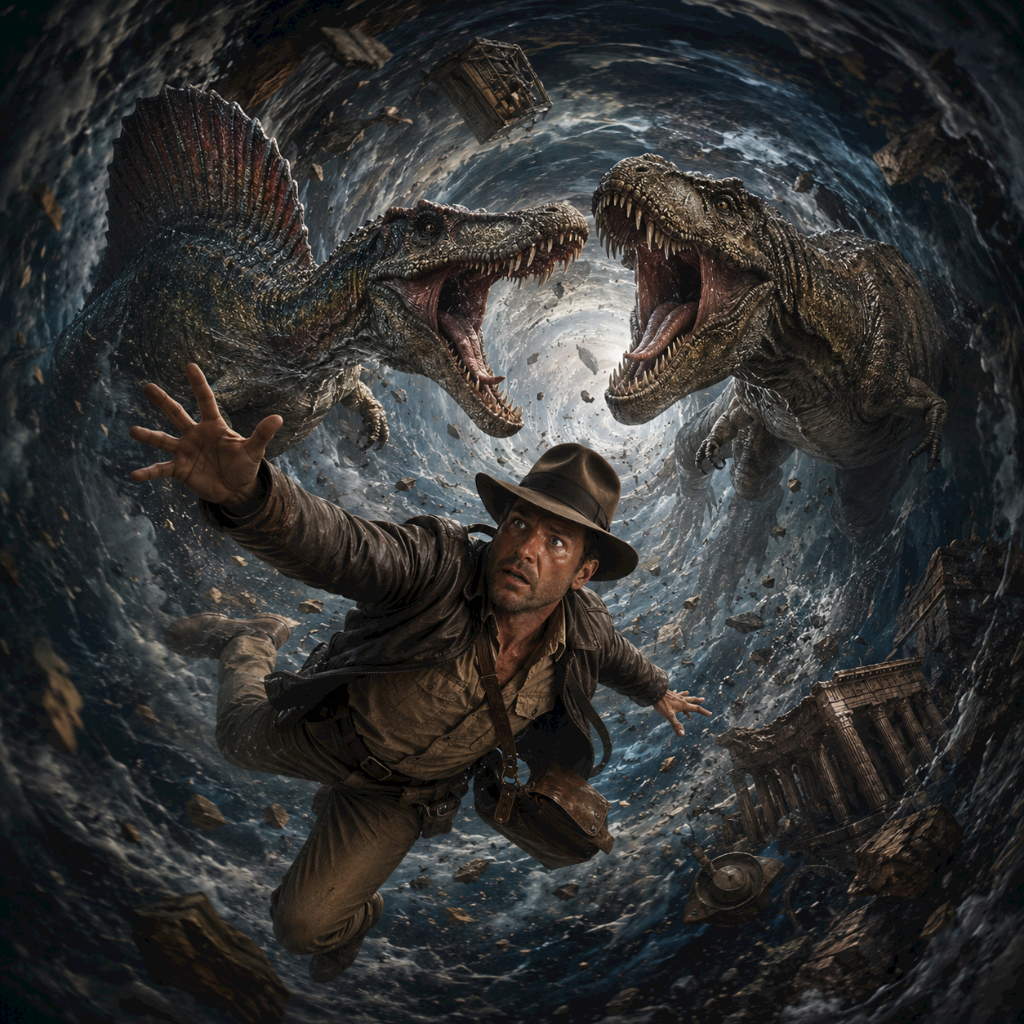
A fellow named Nicholas T. Knox was born in 2285 in the state of Indiana in what was then the United States of America. He grew up watching old science fiction movies, especially ones that involved time travel. He also liked an old movie series about a character named Indiana Jones, an archaeologist and adventurer, but not a time traveler. Young Nick, as he preferred to be called, was so enamored of this character that he began to dress like him in a rugged style that in those days might have been called a "cowboy" look - denim work clothes, a leather jacket, and a cowboy hat. He also adopted that irreverent and almost cynical Indiana Jones attitude.
As Nick grew older, he developed an interest in history. And by history, I mean primarily what was known in your time as prehistory. In a world where time travel is possible, there is no such thing as prehistory anymore, but because of the time travel ban there was such a thing as prehistory in young Nick's time. He wanted to go back in time to see the dinosaurs firsthand and he vowed to himself that nothing would stop him from doing just that.
In short, Nick was a rebel. He certainly looked like one. He acted like one. And, as it turned out, there was a growing underground movement determined to either
lift or evade the ban on time travel. Nick began visiting the dingy coffee shops late at night where these rebels met. On several occasions, Time Enforcement Police (TEP) officers raided the shop where Nick and his rebel group were meeting, and they had to flee. Nick grew to actually enjoy the raids, as crazy as that may sound, because it allowed him to match wits with TEP. He loved the adventure of it all!
As you might imagine, Nick became something of a legend among the anti-ban rebels. And, as his legend grew, his name became well-known to the general public.
In some respects, this was not a good thing. TEP began looking specifically for Nick, offering a big reward for information leading to his capture. On the other hand, his newfound notoriety catapulted him into an unofficial leadership role within the movement.
So, what were these raids all about? Well, you see, back in those days there was something known as the Coffee House Underground (CHU) that had been formulating highly illegal time travel products using forbidden tachyon technology. They had successfully mastered the tachyon, the elusive subatomic faster-than-light particle that is essential to time travel.
These tachyons were hidden in bags of coffee and exchanged in coffee houses among CHU members, who then used them to make illegal forays into the past. They referred to it as "surfing the rainbow", but in reality, it was more like surfing a tornado.
The method was simple enough. First, they would brew the coffee, then pour a cup, and then drink it. Within seconds, the world would seem to slow down, come to a complete stop, and then begin to speed up again - but in reverse. Clocks would appear to be running backwards, a glance out a window might reveal birds flying backwards, nuts chasing squirrels, and so on.
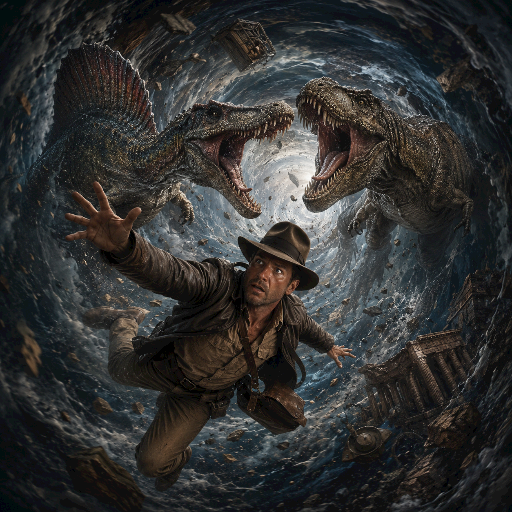
And then, suddenly, they would feel themselves being swept up into a powerful vortex, tossed around like dust in the wind, racing along the spacetime continuum to an unknown destination. The speed was exhilarating, but the buffeting was intense. It was quite an unsettling experience for a first-time traveler, and many arrived battered and bruised at wherever and whenever the vortex happened to drop them. Some forgot to bring along enough coffee for the return trip and had to be rescued by their friends in CHU, assuming that they could be located at all. As I mentioned earlier, few had the stomach for it and many never tried it again.
Time travel was not an exact science in those days. The vortex was a dangerous playground, suitable only for the most adventurous souls. Destinations were iffy and so were returns. Nick rescued dozens for CHU.
With the ever-present threat of TEP raids, secrecy became very important to CHU members. The in-crowd began to communicate using their own slang terms. In addition to phrases like "surfing the rainbow", TEP officers were referred to as "Wile E. Coyotes" and CHU members were called "roadrunners". Adopting this slang gave CHU members a definite cooler-than-thou swagger.
Nick had to make a living, of course, and decided to make his time travel expertise a paying proposition. He began by going back into the past and either bringing back treasure or locating it and then "discovering" it in his own time. For example, he would go back into the past and sneak onto a Spanish galleon laden with gold taken from the New World - a ship that he knew would be lost in a storm. When the storm arrived, he would establish the exact location of the shipwreck and then escape into the vortex as the ship went down. Back in the modern world, he would organize an expedition to "locate" the shipwreck and claim the gold. He claimed - with a wink - to be "the luckiest man in the world."
Over time, it became clear to the authorities that the ban on time travel was not working and before long the law was changed. Some time travel would be allowed, but it would be strictly regulated. Time travelers would have to have a license, which could be revoked if any of the rules were broken.
Nick was one of the first roadrunners to go legit. He quickly realized that doing so would open up vast new opportunities and the one that appealed to him the most was the idea of going back in time and bringing back extinct flora and fauna.
Nick approached zoos, promising that he could bring back creatures from the ice age and possibly beyond, even dinosaurs. The zoos were skeptical at first, but promised to buy them if he did manage to bring them back. He did just that and was paid handsomely for his efforts. Before long, zoos were placing custom orders and Nick became an expert on where to find the various species, how to identify them, how to capture them, etc.
It was around this time in his career that people began calling him Opportunity Knox. The name stuck, he once again became a legend, and he is known to history by that name.
Opportunity Knox was a pioneer in his field, but soon learned that he was not alone in the vortex. There was an assortment of roadrunners from his era, of course, and he knew most of them. Occasionally, though, he would also encounter time travelers from the future - my contemporaries - and they often traveled in very large vehicles, futuristic timeships gliding serenely through the vortex even as he was being tossed around like a rag doll. How, he wondered, were they able to do that? And what would it take to acquire one of those sleek beauties? As we will soon see, it wouldn't be long before he would encounter one of them.
Chapter 4: Professor Warp Speed
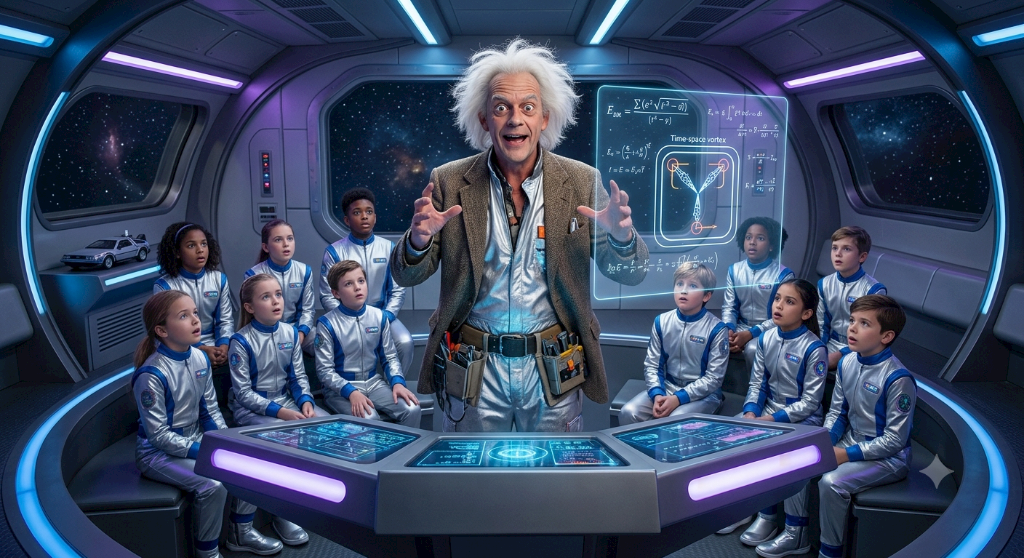
In the year 2853, nearly six centuries after the birth of Opportunity Knox, Irving Schmidlap was born. Young Irving was a bit of a prodigy, speaking at about nine months of age and reading voraciously by age three. He was always at the top of his class, even after skipping several grades in elementary school. He raced through high school, obtained a bachelor's degree at nineteen, a master's degree at twenty, and the first of several doctorates at twenty-two. Dr. Schmidlap, who was highly sought after by academic institutions, soon accepted a professorship at Third Millennium University.
Back in those days, there was a fad among young people of adopting what became known as "zippy names." The idea was to choose a name that better reflected who a person was than did his or her birth name. Dr. Schmidlap liked the idea and decided to adopt the name Professor Warp Speed.
As Professor Warp Speed, he began dabbling in time travel, using the university's fleet of advanced timeships whenever they were available and whenever he could come up with an excuse that sounded like a reasonable academic exercise. The truth, though, was that he just enjoyed the adventure of it all.
As time went on, Professor Warp Speed began to realize that, just as advances in communication and transportation had shrunk the world centuries before, the development of time travel technology had shrunk the world of time.
Ancient historical figures like Flunkin' Duncan and Elon Musk could now be seen as his contemporaries, not just footnotes in some dusty old textbook. He could go back in time and speak to them at different points in their lives, to experience the world that they had inhabited as it actually was, not just as some historian had imagined it to have been.
Professor Warp Speed had become the world's first true spacetime historian. Before long, he was granted tenure and with that came the freedom to do pretty much as he pleased. He also had a reputation that extended well beyond the walls of academia, much like the reputation that Albert Einstein had in the mid-twentieth century. In short, Professor Warp Speed could write his own ticket and he took full advantage of that.
Since he now regarded people of all time as his contemporaries, he began to think in terms of bringing the blessings of an advanced education to the inhabitants of historical times.
Who, he wondered, would likely be the most open to this approach? Children, of course, who had no preconceived notions about the possibility of time travel. He also wanted to begin his experimentation with children from the "modern" age, meaning those who were already living in a world where scientific breakthroughs were commonplace. He decided to restrict his efforts to children born after World War II, in the mid-twentieth century or later.
After proposing his plan to other academics, a heated debate began over ethical considerations. Could this be done ethically and legally and without consent?
That debate raged on for several years and was eventually resolved in Professor Warp Speed's favor. He would have to freeze time, abduct (or "hornswoggle") the child in question, return the child to that exact time and place at the end of the expedition, and then unfreeze time. The idea was that no one except for the hornswoggled child would even be aware that anything had happened and there were very strict rules regarding what information could and could not be given to the child. Most important of all was that no child could ever be taken forward in time or be given detailed information regarding how future technology worked. The ideal age of each child would be about nine or ten.
You may very well have read about some of these adventures, where groups of children from various times and places were all brought together and taken on tours of the past. One group, for example, explored medical history, another traced the history and development of the sport of soccer, and a third made a foray into the last ice age.
As time went on, the traffic to and fro in the spacetime vortex became more and more congested, with some of the earliest pioneers crossing paths with some of the most advanced timeships. It was only a matter of spacetime before they would collide.
Chapter 5: A Bug on the Windshield
In the world as you know it, way back there in the twenty-first century, the idea of actually meeting a historical figure is probably almost unimaginable. As a man of your distant future, I have difficulty with that mindset. Just trust me on this, it can be done.
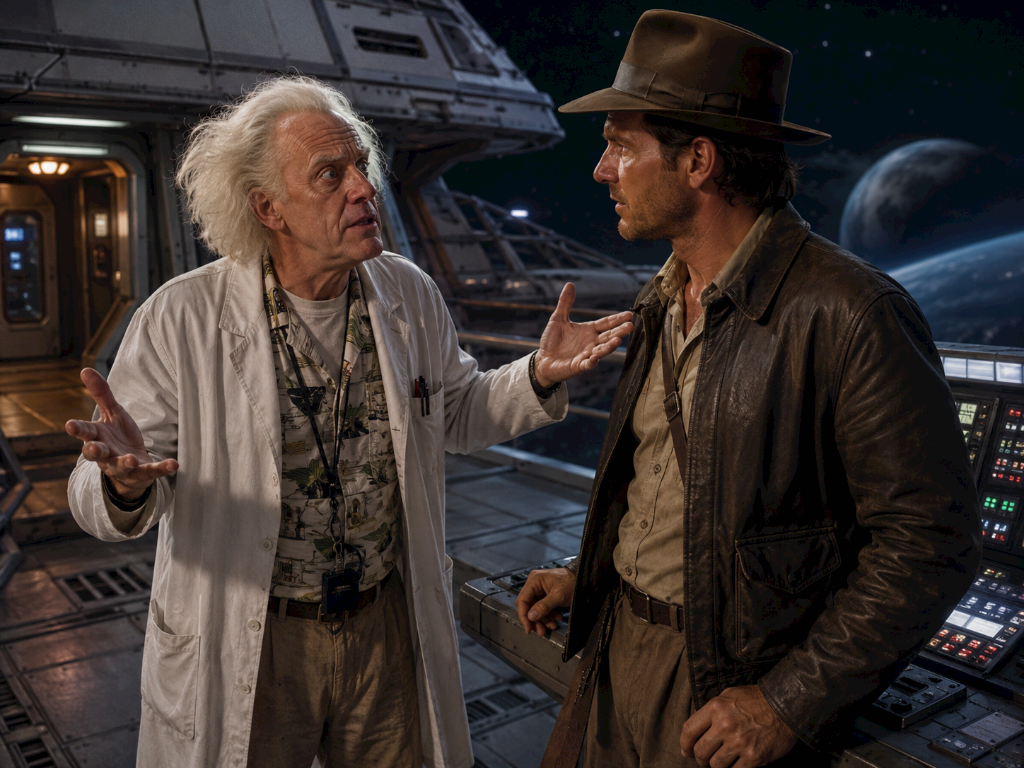
The story that I am going to tell you now is how Opportunity Knox and Professor Warp Speed did just that. It was a chance meeting, to say the least. They literally bumped into each other as they were both hurtling forward in time in the spacetime vortex.
Opportunity Knox had negotiated a deal with a start-up dinosaur zoo to bring back hundreds of dinosaurs, all mating pairs, from a variety of geological periods. If successful, this deal would make him a very wealthy man.
He assembled a team of thirty roadrunners and trained them in the art of dinosaur wrangling, made a deal with a discount tachyon supplier for a large quantity of tachyon fluid (slightly past its expiration date), and a large supply of darts and dart guns. Then he developed a training plan and a detailed six-month plan of action for the world's greatest dinosaur round-up.
- Full access to our public library
- Save favorite books
- Interact with authors
- < BEGINNING
- END >
-
DOWNLOAD
-
LIKE
-
COMMENT()
-
SHARE
-
SAVE
-
BUY THIS BOOK
(from $14.19+) -
BUY THIS BOOK
(from $14.19+) - DOWNLOAD
- LIKE
- COMMENT ()
- SHARE
- SAVE
- Report
-
BUY
-
LIKE
-
COMMENT()
-
SHARE
- Excessive Violence
- Harassment
- Offensive Pictures
- Spelling & Grammar Errors
- Unfinished
- Other Problem






COMMENTS
Click 'X' to report any negative comments. Thanks!