




this book is dedicated to my grade in this class


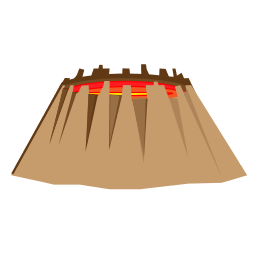
Volcanoes are openings in the Earth's crust where molten rock, called magma, escapes to the surface. When this magma comes out, it is called lava and can be very hot and bright. Over time, the cooled lava and ash build up to form a mountain shape. Some volcanoes erupt with big explosions, while others let lava flow out slowly like a thick syrup. Scientists study these mountains to help keep people safe and learn more about our planet.


Volcanoes are primarily caused by the movement of tectonic plates. Mostly forming at boundaries where plates collide or pull apart. As these plates move, they create gaps or force material into the mantle. Melting it and allowing magma to rise to the surface, especially along the Ring of Fire. The Ring of Fire is a 40,000 km horseshoe-shaped belt around the Pacific Ocean, home to 75% of Earth's active volcanoes and 90% of its earthquakes.


A hot spot is a specific place on Earth where extra-hot rock rises from deep underground. Unlike most volcanoes that form where tectonic plates meet, hot spots can pop up right in the middle of a plate. As the Earth’s plate slowly slides over this stationary hot spot, it creates a chain of volcanoes over millions of years. The active volcano is always directly above the hot spot, while the older ones become quiet as they move away. A famous example of this process is the Hawaiian Islands, which were built one by one as the ocean floor moved.


Island arcs are long chains of active volcanoes found in the ocean that form a curved shape. They are created when two tectonic plates collide, forcing one plate to sink beneath the other in a process called subduction. As the sinking plate melts deep underground. Magma rises to the surface and erupts to build underwater mountains. Over millions of years, these mountains grow tall enough to break the water's surface and become islands.


A long time ago, all of the Earth's continents were stuck together in one giant landmass called Pangea. Over millions of years, this huge landmass broke apart and the pieces began to crawl away from each other slowly. This happened because the continents sit on top of massive "plates" that shift and slide on hot, melted rock deep underground. Even though we cannot feel it, these landmasses are still moving about as fast as your fingernails grow. This slow journey is what created the map of the world we see today.


Scientists proved the existence of Pangea by finding matching fossils, which are the remains or traces of living things from a long time ago that have turned into stone. Scientists discovered that the same types of ancient plant and animal fossils were located on completely different continents. For example, fossils of a small reptile were found in both South America and Africa, even though a wide ocean now sits between them. Since these animals could not swim across the salty sea, it proves the land must have been connected back then. Finding these matching fossils in different places acts like a reminder of how the Earth used to look.

- Full access to our public library
- Save favorite books
- Interact with authors

- < BEGINNING
- END >
-
DOWNLOAD
-
LIKE
-
COMMENT()
-
SHARE
-
SAVE
-
BUY THIS BOOK
(from $2.99+) -
BUY THIS BOOK
(from $2.99+) - DOWNLOAD
- LIKE
- COMMENT ()
- SHARE
- SAVE
- Report
-
BUY
-
LIKE
-
COMMENT()
-
SHARE
- Excessive Violence
- Harassment
- Offensive Pictures
- Spelling & Grammar Errors
- Unfinished
- Other Problem

COMMENTS
Click 'X' to report any negative comments. Thanks!