drawings by Diogo and ai

It was just another Monday morning at school when Alex noticed something strange again.
The classroom bin was overflowing. Plastic bottles, snack wrappers, paper—everything mixed together.
Alex sighed and turned to Mia.
“Why don’t we have recycling bins?” Alex asked.
Mia shrugged. “We used to… I think. But no one really used them properly, so they just disappeared.”
During lunch break, Alex looked around the schoolyard. Students were throwing everything into the same bins. Some didn’t even try to sort their waste.
By Marija, Noa and Elena from Crotia Osnovna Skola Durmanec (Vlatka's Team)
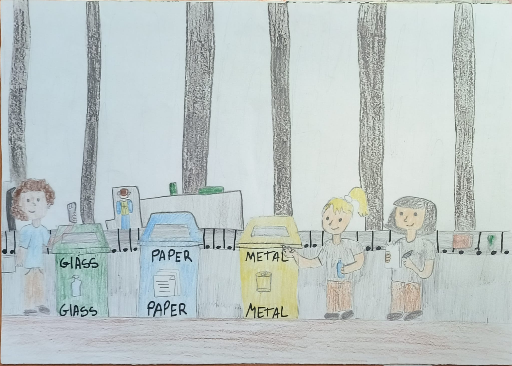
“It feels wrong,” Alex said. “We talk about climate change in class, but we don’t even recycle at school.”
Later that day, Alex brought it up during a student council meeting.
“What if we try to fix this ourselves?” Alex suggested.
“Like how?” someone asked.
“We could start small. Maybe create our own recycling bins—and show everyone how to use them.”
At first, some students laughed.
“You think people will care?”
“Or actually change?”
By Marija, Noa and Elena from Crotia Osnovna Skola Durmanec (Vlatka's Team)
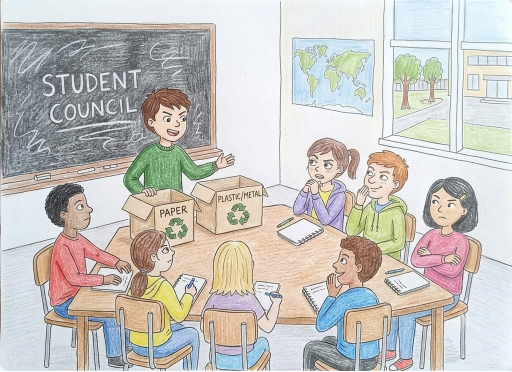
Alex wasn’t sure. But doing nothing didn’t feel right either.
So they decided to try.
The next week, Alex and a few classmates collected cardboard boxes, painted them in different colors, and labeled them: Plastic, Paper, and Other Waste.
They placed them in the hallway and made simple posters explaining what goes where.
At first, almost no one paid attention.
But then something unexpected happened…
On Wednesday morning, Mia stopped in front of the bins and stared. “Wait… someone actually used them,” she said.
By Marija, Noa and Elena from Crotia Osnovna Skola Durmanec (Vlatka's Team)
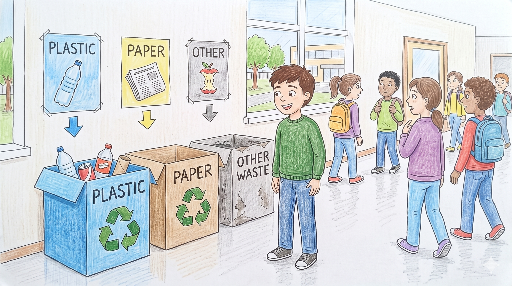
Inside, there were three plastic bottles and a pile of printer paper, all neatly placed. It was a small step, but enough to make Alex smile.
However, by Friday, a new and unexpected problem surfaced—one that had nothing to do with the bins themselves, but with what students were doing while walking through the hallways. Everyone was "glued" to their phones. They passed by the colorful bins like zombies, never looking up from their screens.
By Neda, Vuk, Milica and Aleksa from Serbia (Snežana Kalamković)
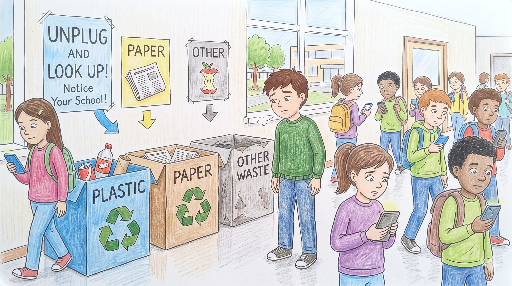
Because of this digital distraction, they didn't just ignore the recycling; they were constantly bumping into each other, and some even dropped trash next to the bins because they weren't even looking where they were aiming.
"Our effort is wasted if no one even sees us because of their screens," Vuk sighed.
That’s when Milica had an idea. "We need to connect their digital world with our bins! People are spending too much time on their phones anyway, so let’s use that for something good."
By Neda, Vuk, Milica and Aleksa from Serbia (Snežana Kalamković)
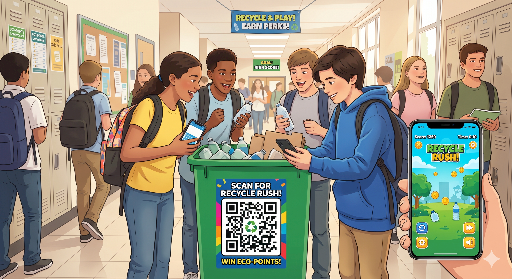
The team decided to stick a large, eye-catching QR codeon each bin. When students scanned it, their phones would open a short, fun 30-second game or a quiz about environmental protection. The best weekly scores earned "eco-points" that could be traded for perks, like an extra five minutes of recess or skipping the line at the school cafeteria.
Instead of fighting the screens, they decided to use them as a tool. Suddenly, students were stopping at the bins—not just to throw away trash, but to compete for the
highest score. The hallway became livelier, and the bins filled up faster than ever.
But just when they thought they had succeeded, an unexpected call to the principal's office changed everything...
By Neda, Vuk, Milica and Aleksa from Serbia (Snežana Kalamković)
As the team walked to the principal's office, they were nervous. They wondered if they were in trouble for the recycling boxes or the QR codes. But when they walked in, they saw the Principal sitting with a guest from the city council.
The Principal looked at them and smiled. "I have seen your project," he said. "The students are finally looking at the bins instead of just their phones."
Emma felt brave and spoke up. "Yes, someone is finally using the bins! But we want to do even more," Emma said.
By Serra and Melike , Ebru APAYDIN, Gediz Atatürk Secondary School
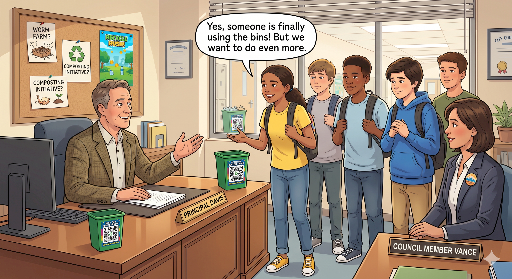
"We want to ask our teacher to take us to the local waste center. We have one in our town." She looked at the Principal and added, "Maybe if students see where the trash goes, they will want to recycle more. Also, I always wonder what happens to the waste after it leaves our school."
The Principal’s smile got even bigger. "That is a great idea, Emma," he said. "Actually, the waste center already heard about your work. They are very happy with how much our school is recycling now. They want to invite your team for a special visit!"
The team was so excited. Their small idea was turning into a big adventure for the whole town.
By Serra and Melike , Ebru APAYDIN, Gediz Atatürk Secondary School
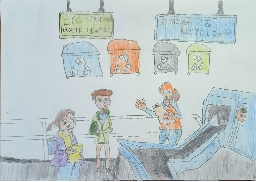
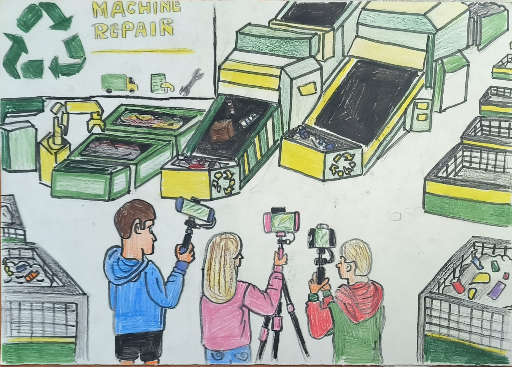
One week later, the entire 7th C class, in fact the whole school, went to the waste centre. Once they arrived there they were overwhelmed with the size of the centre.It was a very modern recycling centre with huge machinery, which separates the different types of garbage: glass; paper and cardboard; plastic and organic waste.
Yevheniia, Martin, and Diego made a video with the whole process so they could share in social media to influence other people to recycle. When the English teacher saw the film she had an idea:
7th C Agrupamento de Escolas Dr. Alberto Iria - Portugal
- Full access to our public library
- Save favorite books
- Interact with authors
- < BEGINNING
- END >
-
DOWNLOAD
-
LIKE
-
COMMENT()
-
SHARE
-
SAVE
-
BUY THIS BOOK
(from $5.59+) -
BUY THIS BOOK
(from $5.59+) - DOWNLOAD
- LIKE
- COMMENT ()
- SHARE
- SAVE
- Report
-
BUY
-
LIKE
-
COMMENT()
-
SHARE
- Excessive Violence
- Harassment
- Offensive Pictures
- Spelling & Grammar Errors
- Unfinished
- Other Problem






COMMENTS
Click 'X' to report any negative comments. Thanks!