 To U.S. History Class '12
 This book was created and published on StoryJumper™
©2010 StoryJumper, Inc. All rights reserved.
Publish your own children's book:
www.storyjumper.com

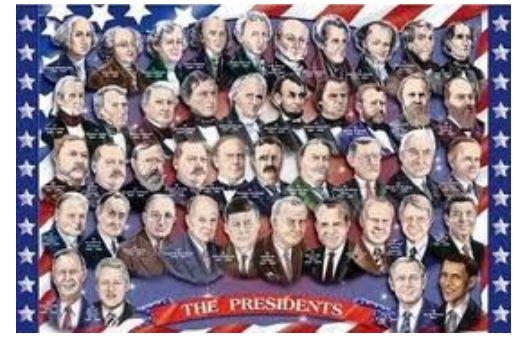
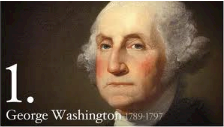
During Presidency
George Washington was the 1st president of the United States of
America.
He was president for eight years, from 1789-1797.
Some of the issues he faced throughout his presidency were, the
Whiskey Rebellion, in which Washington sent in 15,000 to 20,000
soldiers to rebels. In foreign affairs, Washington was a huge proponent of
neutrality. He declared the Proclamation of Neutrality in 1793 which
stated that the US would be impartial toward belligerent powers currently
in a war. This upset some who felt we owed a greater allegiance to
France. His belief in neutrality was reiterated during his Farewell Address
in 1796, where he warned against foreign entanglements. This warning
became part of the American political landscape.Washington signed Jay's
Treaty which gave away the United State's right to neutrality of the seas
allowing the British to search and seize anything they found on American
ships traveling into ports of Britain's enemies. In return, the British
withdrew from outposts in the Northwest Territory. This forestalled
further conflict with Great Britain until 1812.In 1795, Pinckney's Treaty
helped relations with Spain by creating a boundary between the United
States and Spanish held Florida. Further, the US was allowed to travel
the entire Mississippi for purpose of trade.
 George Washington
Before/After Presidency
Before he was president, George was in the military from
1752- 1758 before being elected to the Virginia House of
Burgesses in 1759. He led the Continental Army from
1775-1783 during the American Revolution. He then
became the president of the Constitutional Convention in
1787.
After he was president, George didn't run a third time.
He retired to Mount Vernon. He was again asked to be
the American commander if the US went to war with
France over the XYZ affair. However, fighting never
occurred on land and he did not have to serve. He died
on December 14, 1799 possibly from a streptococcal
infection of his throat made worse from being bled four
times.
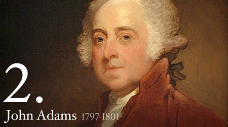
 John Adams
Before/After Presidency
Adams began his career as a lawyer. He successfully
defended the British soldiers involved in the Boston Massacre
with only two of the eight found guilty of manslaughter
believing that it was important to ensure that innocents were
protected.
John Adams lived for over 25 years after failing to be
reelected to the presidency. He returned home to
Massachusetts. He spent his time learning and corresponding
with old friends including mending fences with Thomas
Jefferson and beginning a vibrant letter friendship. He lived to
see his son, John Quincy Adams, to become president. He
died on July 4, 1826, the same day as Jefferson’s death.
During Presidency
John Adams was the 2nd president of the United States of America.
He was president for four years, from 1797-1801.
Adam's major accomplishment was to keep America out of war with
France and normalize relations between the two countries. When he
became president, relations were strained between the United States
and France mainly because the French were making raids on
American ships. In 1797, Adams sent three ministers to try and work
things out. However, the French would not accept the ministers.
Instead, the French Minister Talleyrand sent three men to ask for
$250,000 in order to resolve their differences. This event became
known as the XYZ Affair and caused public uproar against France.
Adams had to act quickly to avoid war by sending another group of
ministers to France to try and preserve the peace. This time they
were able to meet and come to an agreement allowing the US to be
protected on the seas in exchange for granting France special trading
privileges.
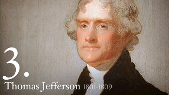

 Thomas Jefferson
During Presidency
Thomas Jefferson was the 3rd president of the United States of
America.
He served as president for eight years.From 1801-1809.
During his presidency, Jefferson spent time dealing with the
federalist agenda with which he did not agree. He allowed the Alien
and Sedition Acts to end without renewal. He had the tax on liquor
that caused the Whiskey Rebellion repealed. This reduced
government revenue leading Jefferson to cut costs by reducing the
military, relying instead on state militias. An important event
during Jefferson's presidency, was the court case of Marbury v.
Madison, which set up the Supreme Court's power to rule federal
laws unconstitutional. In 1803, Jefferson purchased the Louisiana
territory from France for $15 million. This is considered the most
important act of his administration. He sent Lewis and Clark on
their famous expedition to explore the new territory. In 1807,
Jefferson ended the foreign slave trade beginning January 1, 1808.
He also established the precedent of Executive Privilege.
Before/After Presidency
Jefferson served in the House of Burgesses He argued against
Britain's actions and was part of the Committee of
Correspondence. He was a member of the Continental Congress
and then became a member of the Virginia House of Delegates.
He was the Governor of Virginia . during part of the Revolutionary
War. As a member of the second Continental Congress, he wrote
the Declaration of Independence. He was sent to France as a
minister after the war. During Washington's Presidency, he was
Secretary of State, he would get in clashes with Alexander
Hamilton, Secretary or Treasury. Hamilton also desired a stronger
federal government than Jefferson. Jefferson eventually resigned
because he saw that Washington was more strongly influenced by
Hamilton than him. He also wrote the Declaration of
Independence in 1776.
After his presidency, Jefferson retired after his second term as
president and did not reenter public life again. He spent time at
Monticello. He was deeply in debt and in 1815 sold his library to
form the Library of Congress and to help get him out of debt. He
spent a lot of his time in retirement designing the University of
Virginia. He died on the fiftieth anniversary of the Declaration of
Independence, July 4, 1826. Ironically, this was the same day as
John Adams.
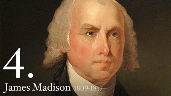
 James Madison
During Presidency
James Madison was the 4th president of the United States of America.
He served as president for eight years. From 1809-1817.
At the beginning of Madison's presidency, he attempted to enforce the Non-
Intercourse Act. This allowed the US to trade with all nations except France and
Great Britain because of the attacks on American shipping by those two
nations. Madison offered to trade with either nation if it would stop harassing
American ships. However, neither agreed. In 1810, Macon's Bill No. 2 was
passed that repealed the Non-Intercourse Act and instead said that whichever
nation would stop harassing American ships would be favored and the US would
stop trading with the other nation. France agreed to this and the British
continued to stop American ships and impress sailors. America participated in
the War of 1812 during Madison's time in office. The British were impressing
American sailors and seizing goods. Madison asked Congress to declare war,
although support was anything but unanimous. America began poorly with
General William Hull surrendering Detroit without a fight. America did well on
the seas and eventually retook Detroit. The British were able to march on
Washington and burn the White House. However, by 1814, the US and Great
Britain agreed to the Treaty of Ghent which resolved none of the pre-war
issues.
Before/After Presidency
Before he was president, Madison wrote most of
the US Constitution at the Constitutional
Convention in 1787. Even though he would later
write the Virginia Resolutions which were hailed
by anti-federalists, his Constitution created a
strong federal government. Once the Convention
ended, he along with John Jay and Alexander
Hamilton wrote the Federalist Papers, essays that
were intended to sway public opinion to ratifying
the new Constitution.
After he was president, Madison retired to his
plantation in Virginia. However, he still stayed
involved in political discourse. He represented his
county at the Virginia Constitutional Convention
(1829). He also spoke against nullification, the
idea that states could rule federal laws
unconstitutional. His Virginia Resolutions were
often cited as a precedent for this but he believed
in the strength of the union above all. He also
helped found the American Colonization Society
to help resettle freed blacks in Africa.
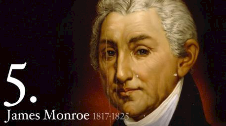
 James Monroe
During Presidency
James Monroe was the 5th president of the United States of America.
He served for eight years. From 1817-1825.
During his time in office, Monroe had to contend with the First Seminole
War. When Seminole Indians and escaped slaves raided Georgia from
Spanish Florida. Monroe sent Andrew Jackson to rectify the situation.
Despite being told not to invade Spanish held Florida, Jackson did and
deposed the military governor. This eventually led to the Adams-Onis
Treaty where Spain ceded Florida to the United States. It also left all of
Texas under Spanish control.In 1819, America entered its first economic
depression (at that time called a Panic). This lasted until 1821. Monroe
made some moves to try and alleviate the effects of the depression.
Two major developments during Monroe's presidency were the Missouri
Compromise and the Monroe Doctrine. The Missouri Compromise
admitted Missouri into the Union as a slave state and Maine as a free
state. It also provided that the rest of the Louisiana Purchase above
latitude 36 degrees 30 minutes was to be free.
Before/After Presidency
Before his presidency,he was a member of the Virginia
Assembly. He joined the Continental Congress. He left to
practice law and became a Senator. He was sent to
France as a Minister and was recalled by Washington. He
was elected Virginia Governor. He was sent in 1803 to
negotiate the Louisiana Purchase. He then became
minister to Britain. He served as Secretary of State,
while concurrently holding the post of Secretary of War.
After his presidency, Monroe retired to Oak Hill in
Virginia. In 1829, he was sent to and named the
president of the Virginia Constitutional Convention. He
moved to New York City upon his wife's death. He died
on July 4, 1831.
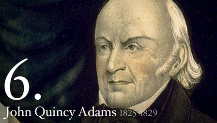
 John Quincy Adams
Before/After Presidency
Adams opened a law office before becoming a minister
to the Netherlands. He then was named Minister to
Prussia. He served as a US Senator, and was then
appointed by James Madison as Minister to Russia. He
became Minister to Great Britain in 1815 before being
named as James Monroe's Secretary of State.He was
the chief negotiator of the Treaty of Ghent.
Adams became the only President elected to the US
House in 1830 after serving as president. He served
there 17 years. One key event during this time was his
role in arguing before the Supreme Court to free the
slave mutineers aboard the Amistad. He died after
having a stroke on the floor of the US House on
February 23, 1848.
During Presidency
John Quincy Adams was the 6th president of the United States of
America.
He served for fours years. From 1825-1829.
John Quincy Adams served only one term as president. He
supported internal improvements including the extension of the
Cumberland Road. In 1828, the so-called "tariff of abominations"
was passed. Its goal was to protect domestic manufacturing. It was
strongly opposed in the South and led Vice President John C.
Calhoun to argue again for the right of nullification - to have South
Carolina nullify it by ruling it unconstitutional.
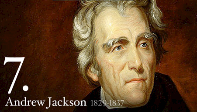
 Andrew Jackson
Before/After Presidency
Andrew Jackson joined the Continental Army at 13. He
and his brother were captured and held for two weeks.
As major general of the Tennessee Volunteers, Jackson
led his troops to victory in March 1814 against the
Creek Indians at Horseshoe Bend. In May 1814 he was
made Major General of the army fighting the War of
1812. On January 8, 1815, he defeated the British in
New Orleans and was lauded as a hero. He also served
in the 1st Seminole War when he overthrew the
Spanish Governor in Florida. Andrew Jackson was a
lawyer in North Carolina and then Tennessee. In 1796,
he served at the convention that created the
Tennessee Constitution. He was elected in 1796 as
Tennessee's first US Representative and then as US
Senator in 1797 from which he resigned after eight
months
Andrew Jackson returned to his home, the Hermitage,
near Nashville, Tennessee. He stayed active politically
until his death on June 8, 1845
During Presidency
Andrew Jackson was the 7th President of the UNited States of America.
He served as president for eight years. From 1829-1837.
During Jackson's presidency, sectional issues began to arise. Many Southern
states wished to preserve state's rights. They were upset over tariffs and
when in 1832, Jackson signed a moderate tariff, South Carolina felt they had
the right through "nullification" (the belief that a state could rule something
unconstitutional) to ignore it. Jackson stood strong against South Carolina,
ready to use the military if necessary to enforce the tariff. In 1833, a
compromise tariff was enacted that helped mollify the sectional differences
for a time.In 1832, Jackson vetoed the Second Bank of the United State's
charter. He believed the government could not constitutionally create such a
bank and that it favored the wealthy over the common people. This action
led to federal money being put into state banks who then loaned it out freely
leading to inflation. Jackson stopped the easy credit by requiring all land
purchases be made in gold or silver which would have consequences in
1837.Jackson supported Georgia's expulsion of the Indians from their land
to reservations in the West. He used the Indian Removal Act of 1830 to
force them to move, even discounting the Supreme Court ruling in
Worcester v. Georgia that said they could not be forced to move. From
1838-1839, troops led over 15,000 Cherokees from Georgia in what is called
the Trail of Tears.
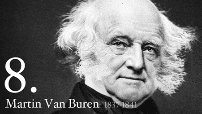
 Martin Van Buren
Before/After Presidency
Before his presidency, Martin Van Buren became a
lawyer in 1803. In 1812, he was elected a New York
State Senator. He was then elected to the US Senate in
1821. He worked while Senator to support Andrew
Jackson in the Election of 1828. He held the seat of New
York Governor for only three months in 1829 before
becoming Jackson's Secretary of State. He was
Jackson's Vice President during his second term.
After his presidency, Martin Van Buren was defeated for
reelection by William Henry Harrison in 1840. He tried
again in 1844 and 1848 but lost both of those elections.
He then decided to retire from public life in New York.
However, he did serve as electors for Franklin Pierce
and James Buchanan. He also endorsed Stephen
Douglas over Abraham Lincoln. He died on July 2, 1862
of heart failure.
During Presidency
During his presidency, Martin Van Buren's administration began with a
depression that lasted from 1837 until 1845 called the Panic of 1837.
Over 900 banks eventually closed and many people went unemployed.
To combat this, Van Buren fought for an Independent Treasury to help
ensure the safe deposit of funds.Issues arose with British held Canada
during Van Buren's time in office. One such event was the so-called
"Aroostook War" of 1839. This nonviolent conflict arose over thousands
of miles where the Maine/Canadian border had no defined boundary.
When a Maine authority tried to send Canadians out of the region,
militias were called forward. Van Buren was able to make peace through
General Winfield Scott before fighting began.Texas applied for statehood
after gaining independence in 1836. If admitted, it would have become
another slave state which was opposed by the Northern states. Van
Buren, wishing to help fight against sectional slavery issues, agreed with
the North. Also, Van Buren continued Jackson's policies concerning the
Seminole Indians. In 1842, the Second Seminole War ended with the
Seminoles being defeated.
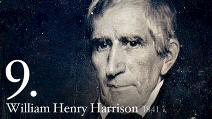
 William Henry Harrison
Before Presidency
Harrison began the War of 1812 as the Major
General of the Kentucky militia and ended as Major
General of the Northwest Territories. He led his
forces to retake Detroit. He then defeated a force of
British and Indians including Tecumseh at the
Battle of the Thames. He resigned from the military
in May, 1814.Harrison left military service in 1798
to become the Secretary of the Northwest Territory
and then became the Northwest Territory delegate
to the House before being appointed Governor of
the Indian Territories.This was when Tippecanoe
occurred.After the War of 1812, he was elected US
Representativeand then State Senator.From 1825,
he served as a US Senator. He was sent as US
Minister to Columbia from 1828.
During Presidency/Death
William Henry Harrison was the 9th president of the United States of
America.
He served as president for one month. From March 4- April 4, 1841.
When Harrison took office, he gave the longest inaugural address ever
talking for one hour and 40 minutes. It was delivered in the cold during
the month of March. He then got caught in the rain and in the end came
down with a cold. His illness got worse until he finally died on April 4,
1841. He did not have the time to accomplish much and spent most of his
time dealing with job seekers.William Henry Harrison was not in office
long enough to really have a significant impact. He only served one
month, from March 4 until April 4, 1841. He was the first president to die
in office. In accordance with the Constitution, John Tyler took over the
presidency.
FUN FACT:
William Henry Harrison was the grandfather of the 23rd President-
Benjamin Harrison.
His father Benjamin Harrison V signed the Declaration of Independence.
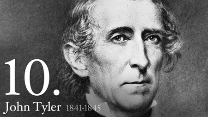
 John Tyler
Before/After Presidency
Before his presidency,John Tyler was a member of the
Virginia House of Delegates. In 1813, he did join the
militia but never saw action. In 1816, Tyler was
elected to be a U.S. Representative. He strongly
opposed every move towards power for the Federal
government that he saw as unconstitutional. He
eventually resigned. He was Governor of Virginia from
1825-1827 until he was elected a U.S. Senator.
John Tyler did not run for reelection in 1844. He
retired to his farm in Virginia and later served as
Chancellor of the College of William and Mary. As the
Civil War approached, Tyler spoke for secession. He
was the only president to join the Confederacy. He
died on January 18, 1862 at the age of 71.
During Presidency
John Tyler was the 10th president of the United States of America.
He served as president for four years. From 1841-1845
John Tyler was the Vice President under William Henry Harrison in the
election of 1840. He was chosen to balance the ticket since he was from the
South. He took over upon Harrison's quick demise after only one month in
office. He was sworn in on April 6, 1841 and did not have a Vice President
because no provisions had been made in the Constitution for one. In fact,
many tried to claim that Tyler was actually only "Acting President." He
fought against this perception and won legitimacy. During his presidency,in
1841, John Tyler's entire cabinet except Secretary of State Daniel Webster
resigned. This was due to his vetoes of laws creating the Third Bank of the
United States. This went against his party's policy. After this point, Tyler
had to operate as president without a party behind him.In 1842, Tyler
agreed to and Congress ratified the Webster-Ashburton Treaty with Great
Britain. This set the boundary between Maine and Canada. The border was
agreed upon all the way to Oregon. President Polk would deal in his
administration with the Oregon border.1844 brought the Treaty of Wanghia.
According to this treaty, America gained the right to trade in Chinese ports.
America also gained the right of extraterritoriality with U.S. citizens were
not under the jurisdiction of Chinese law.In 1845, three days before leaving
office, John Tyler signed into law the joint resolution allowing for the
annexation of Texas. Importantly, the resolution extended 36 degrees 30
minutes as the mark dividing free and slave states through Texas.
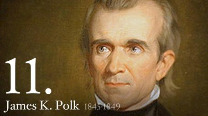
 James K. Polk
After Presidency
Polk was focused on politics his whole life. He was a
member of the Tennessee House of
Representatives.From 1825-39, he was a member of
the U.S. House of Representatives including serving
as its speaker from 1835-1839. He was a great ally
and supporter of Andrew Jackson. From 1839-1841,
Polk became Governor off Tennessee.
Polk had announced before taking office that he
would not seek a second term. He did retire at the
end of his term. However, he did not live much past
that date. He died only three months later, possibly
from Cholera.
During Presidency
James K. Polk was the 11th president of the United States of America.
He serves as president for four years. From 1845-1849.
James K. Polk's time in office was eventful. In 1846, he agreed to fix the
boundary of the Oregon territory at the 49th parallel. Great Britain and the
United States disagreed about who claimed the territory. The Oregon
Treaty mean that Washington and Oregon would be a territory of the U.S.
and Vancouver would belong to Great Britain.Much of Polk's time in office
was taken up with the Mexican War which lasted from 1846-1848. The
annexation of Texas which had taken place at the end of John Tyler's time
in office hurt relations between Mexico and America. Further, the border
between the two countries was still disputed. The U.S. felt that the border
should be set at the Rio Grande River. When Mexico would not agree, Polk
prepared for war. He ordered General Zachary Taylor to the area.In April,
1846, Mexican troops fired on the U.S. troops in the area. Polk used this to
push forward a Declaration of War against Mexico. In February, 1847,
Taylor was able to defeat the Mexican army led by Santa Anna. By March,
1847, U.S. troops occupied Mexico City. Concurrently in January, 1847,
Mexican troops were defeated in California.In February, 1848, The Treaty of
Guadalupe Hidalgo was signed ending the war. By this treaty, the border
was fixed at the Rio Grande. By this means, the U.S. gained California and
Nevada amongst other present day territories amounting to over 500,000
square miles of land. In exchange, the U.S. agreed to pay Mexico $15
million for the territory. This agreement reduced the size of Mexico to half
of its former size.
You've previewed 14 of 22 pages.
To read more:
Click Sign Up (Free)- Full access to our public library
- Save favorite books
- Interact with authors


- < BEGINNING
- END >
-
DOWNLOAD
-
LIKE(1)
-
COMMENT()
-
SHARE
-
SAVE
-
BUY THIS BOOK
(from $4.39+) -
BUY THIS BOOK
(from $4.39+) - DOWNLOAD
- LIKE (1)
- COMMENT ()
- SHARE
- SAVE
- Report
-
BUY
-
LIKE(1)
-
COMMENT()
-
SHARE
- Excessive Violence
- Harassment
- Offensive Pictures
- Spelling & Grammar Errors
- Unfinished
- Other Problem
"Presidents of the US"
P.S. You might need to view the book larger... Sorry.





COMMENTS
Click 'X' to report any negative comments. Thanks!