
To Jen

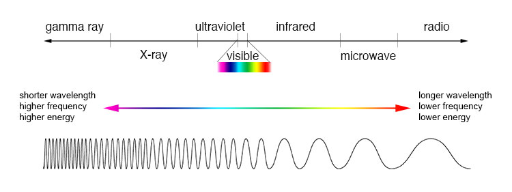
The speed of light is about 300,000 kilometers/second. To put this in perspective, you could travel around the Earth 7.5 times in one second when going the speed of light. Theoretically, nothing can travel faster than light. The electromagnetic spectrum classifies the various different types of light waves, which all travel at this speed, but at varying frequencies and wavelengths.
The electromagnetic spectrum is the entire range of frequencies and wavelengths that make up all forms of light waves. This includes radio waves, microwaves, visible light, and x-rays among others. Although there are seven different sections of the electromagnetic, only a very small section of it is visible to human eyes.

Radio waves have the longest wavelength of any wave within the electromagnetic spectrum. Their frequencies can range anywhere from 300 gigahertz (GHz) to 3 kilohertz (kHz) and their wavelengths span from 1 millimeter (mm) to 100 kilometers (km). Radio waves include the broadcasting of literal radio; AM and FM have various frequencies that affect the distance the frequency can be sent as well as the clearness of the sound. Other examples include communication systems used in submarines and waves that transmit television signals into your home.
Microwaves have waves ranging in wavelength from 1 meter (m) to 1 millimeter (mm). Their frequencies are between 300 megahertz (MHz) to 300 gigahertz (GHz). The prefix ‘micro-’ does not indicate that the waves are micrometers long, but rather that they are smaller than radiowaves. The most commonly thought of form of microwaves are used in a literal microwave to heat food. Microwaves are often used in communication devices such as in satellite-based communication; the sun also emits microwaves.

Infrared light’s wavelengths vary from 0.74 micrometers to 1 millimeter (mm) and the frequencies span from 300 gigahertz (GHz) to 1 terahertz (THz). Infrared light is divided into three groups: far-infrared, mid-infrared, and near-infrared. They are categorized based on their corresponding frequencies and wavelengths. Infrared light, also known as heat radiation, includes a majority of thermal radiation from objects near room temperature. Infrared radiation can be used to measure the temperature of objects and is commonly used in heat cameras or weather models. Infrared light can also be felt as heat in objects such as fires, stoves, light bulbs, coals, or even people. Although we can not feel it, it can be perceived through touch and feel.
- Full access to our public library
- Save favorite books
- Interact with authors

- < BEGINNING
- END >
-
DOWNLOAD
-
LIKE(1)
-
COMMENT()
-
SHARE
-
SAVE
-
BUY THIS BOOK
(from $3.59+) -
BUY THIS BOOK
(from $3.59+) - DOWNLOAD
- LIKE (1)
- COMMENT ()
- SHARE
- SAVE
- Report
-
BUY
-
LIKE(1)
-
COMMENT()
-
SHARE
- Excessive Violence
- Harassment
- Offensive Pictures
- Spelling & Grammar Errors
- Unfinished
- Other Problem

COMMENTS
Click 'X' to report any negative comments. Thanks!