eTwinning Project " Life Tree "
February - May 2023
Part one
My Guardian Tree

About our Project
Nowadays, when the use of technology increases and isolating oneself at home is increasing, the time we spend with nature decreases day by day.
But our connection with nature will never end.
Understanding the system of nature and protecting it, is now more important than before.
Our aim is to emphasize the importance of the tree, which is one of the most important parts of nature, for all living things, and to draw attention to this issue.
This is a multinational project between schools from Greece, Turkie, Poland and Romania and this book is about the first part of it..
"My Guardian Tree"
Guardian Trees
But.. What's a guardian tree?
The Tree is a common universal, archetypal symbol that can be found in many different traditions around the ancient world. Trees are symbols of physical and spiritual nourishment, transformation and liberation, sustenance, spiritual growth, union and fertility.
Guardian tree is a title that was given to five special trees which were in ancient times considered sacred. According to folklore, a tall stranger, some say a giant as high as a wood, came to the court of the High King at Tara, bearing a branch from which grew three fruits: an apple, an acorn, and a hazelnut.
Those five trees were the five sacred trees of Ireland!
Giorgos An. 5th grade, Dystos' Primary School
Source: https://stairnaheireann.net

Trees in Greek Mythology
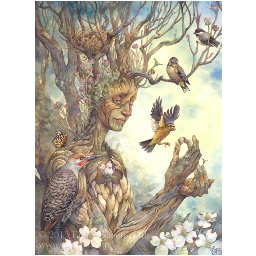
In Greek Mythology, Dryads were originally considered the nymphs of oak trees specifically, but the term has evolved towards tree nymphs in general, or human-tree hybrids in fantasy.
Often their life force was connected to the tree in which they resided and they were usually found in sacred groves of the gods. They were considered to be very shy creatures except around the goddess Artemis, who was known to be a friend to most nymphs.
Types of Dryads
Daphnaie
These were nymphs of the laurel trees.
Epimelides
These were nymphs of apple and other fruit trees.
Hamadryad
These were an integral part of their trees, such that if the tree died, the hamadryad associated with it also died.
Meliae
These were the dryads of the ash tree
Dryads
Anastasia, 6th grade, Dystos Primary School
Source: https://en.wikipedia.org

Kyparissos was the youngest child of the king of Chios and had gained the favor of god Apollo. In a gesture of favor, Apollo gave him a domesticated sacred deer for companionship, with which Cyparissos formed an inseparable bond.
One day Cyparissos went out hunting in the forest where his deer was running and without realizing it was it. he killed it. When he recognized his beloved animal he burst into tears and asked Gods to die with it. Apollo took pity on the inconsolable youth and decided to relieve him of his misery. So he transformed him into a cypress tree, a tall and beautiful tree.
The cypress has since become a symbol of mourning.
Eleftheria, 6th grade, Dystos Primary School
Source: https://mikropragmata.lifo.gr
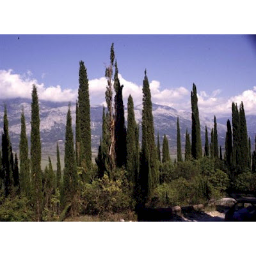
The myth of cypress
( kyparissi )

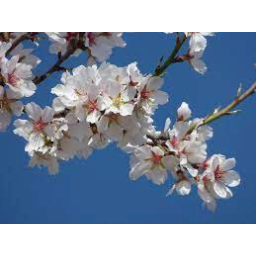
Phyllis was a beautiful princess from Thrace, who fell in love with Theseus' son, Demophon, when he was returning from Troy. The two young people got married, but Demophon soon became homesick for his homeland, Athens, and wanted to return to it. Phyllis let him go back because she believed that if he really loved her he would come back. However, the enamored princess waited for her lover for years until he withered and died. The Gods, seeing her grief, gave her another chance by transforming her into a tree, so that she could wait for Demophon. So Phyllis turned into the tree that became a symbol of hope, the Almond tree.
According to the legend, Demophon returned to Thrace and found his wife a dry tree without leaves in the middle of the frozen landscape. Full of remorse he embraced her trunk and she then flooded with flowers in the middle of winter defeating death.
The princess never returned to her human form. It remained a tree and every year in January, it is decorated with white flowers as the first tree of spring.
Almond tree
Vasiliki, 6th grade, Dystos Primary School
Source: https://mikropragmata.lifo.gr

When Cecrops, son of Earth and Sky, founded the city later called Athens two gods, Athena and Poseidon, claimed its protection.
First, Poseidon brought water as a gift to the city by striking the rock of the Acropolis with his trident (according to another version of the myth, Poseidon brought as a gift a war horse from the foam of the sea).
Then the goddess Athena hit the rock with her spear and an olive tree grew. None of the two gods would back down and so the rest of the gods of Olympus were called to decide on the protection of the city.
Athena managed to gather the most votes and finally got the protection of the city which was named Athens and had the olive tree as its symbol! In fact, the trees that came from Athena's olive tree were sacred trees and were protected by Zeus or "Morius Zeus".
Panagiota, 6th grade, Dystos Primary School
Source: https://www.gardenguide.gr
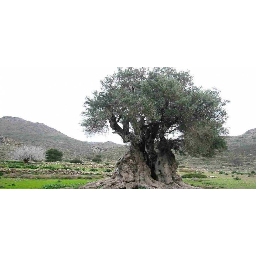
Olive Tree

A creation of 2nd grade
Dystos' Primary School

Trees in Fairy tails..
Source: https://foodtank.com/
Some fairy tales begin with: "Long ago, when the trees could talk ..
The tale of Frau Holle (Grimm), Marie along a tree full of ripe apples that say they want to be shaken.
In the fairy tale of Hansel play is death by a wily hero on a tree pinned. Everyone is happy because nobody needs to die. But eventually, the many old people are a burden on the community. The sick who would want to kill themselves may not die. So the dead back from his exile freed.
In the fairy The spirit in the glass (Grimm) is a woodcutter under a tree a ghost who is stuck. With his release the man finds his happiness.
In the tale the old woman in the forest (Grimm) we meet a prince and his entourage from trees that are changed. Using a poor servant girl who works the magic ring of the old witch to steal, they get their old human form again.
Trees are sacred and sometimes protective, sometimes dangerous and threatening.
The tree as a mirror for man
The tree in the fairy tale people also hold a mirror like in the fairy tale of the pine tree that would have other leaves (Anderson). His wish was granted. He woke up and had leaves of gold. A robber and plucked all the leaves off. When the desired tree leaves of clear glass. Also, this wish was fulfilled. A storm blew the glass leaves the air. They fell to the ground and splintered. Finally the tree was only the needles back and was thrilled when that happened.
Source: http://voiceofthetrees.blogspot.com/
Giannis, 6th grade, Dystos' Primary School

- Full access to our public library
- Save favorite books
- Interact with authors
In Tengrism, the belief of the ancient Turks and Mongols, and the indigenous beliefs of North America, there is also the "tree of the Worlds", which is believed to stand at the center of the world and unite the heavens and the earth. Traces of tree worship have been preserved until the Oghuzs: Beliefs similar to the belief in the sacred "Evliya Tree", called "Mr. Terek", "Temir Kavak", or "Tree of Life", can be found not only in Turkish mythology but also in all world mythologies.
Symbolic Meanings
When we look at the Turkish ethnic-cultural tradition, the tree myth, which has an important place, is shown as one of the main motifs of the reason for its creation in Turkish thought. According to this idea, the first man was created under a nine-knotted tree. In Turkish mythology, "Evliya Agac" is the way to reach God. According to the belief, the gaze of some sacred trees, like the lofty mountains, rises too high to be seen with the naked eye and reaches the light-filled realm of heaven, which is thought to be in the sky. Heaven is turned into the visible side of the Great God. Thus, "Evliya Great Tree" has become the symbol of God's divine attributes on the material earth in Turkish thought, in other words, it symbolized it. The tree also symbolizes the bond of people with each other and nature with people in the traditional worldviews of Turkish peoples.
The Sacred Trees of Saints, which symbolize God, have many features in terms of their compatibility with the definition in Turkish mythology; These trees are unique and unique, symbolizing immortality and being a place of refuge. These features are also the features of the "Great Sky God". Therefore, the tree was considered sacred and cutting it was considered a sin. Like God Mountain, "Evliya Agac" represents God in theism of Turkish mythology.
In Turkish peoples, there are traditions known as "frightening the tree" for the trees to be fertile or for the trees that did not produce fruit for a few years. The interpretation of seeing a blossoming tree in sleep as a sign of a child coming to the world, and seeing a fallen tree as a sign of death is a product of ancient beliefs attached to trees. According to the mythological belief, there is a tree in the afterlife, every leaf of which belongs to a person on this earth; A person dies when the leaf turns yellow and falls to the ground. In the nights of power, it is believed that the waters stop and the trees go into prostration.
Historical Origins
It shows that in the eyes of the Turks, the Great Tree has the divine attributes of God. It was the tree that fell into the sleep of Osman Gazi, the founder of the Ottoman State, and told how far his dominion would extend, that spread branches and knots, and the shadow of its knots covered all four sides.
The tree motif in Sayan Altay folk culture is related to the owner motif. Here, the tree is where the Great Mother lives and gives milk to the heroes from her breast. The elders of the Khakas see the expression of the power connected with the ancestral realm in the underworld in the roots of the beech tree. It is also very common for Turkish peoples to refer to the great trees with the names of saints. Lonely trees occupied an important place in mythological beliefs, probably because they symbolized the oneness of God.
Names such as “World Tree”, “Shaman Tree”, “Mr. Terek” are found in literatures about the mythology of “Evliya Ağaç”. “Tree of Life” in the mythology of the peoples of the world; “Mr Kayink” in Altai Turkish mythology; In some stories, the names "Tamir Terek" are mentioned.
The roots of this tree, which rises from the middle of the world, go underground, and its branches rise to the top of the world mountain. Thus, this sacred tree connects all three layers of the world - the heaven, the earth and the underworld.
The tree that the shamanist Turks consider the most sacred is the beech tree. This tree, which is called "Mr. Beech" because it is considered sacred, takes place in all shamanic rites. Beech, which is a tree motif, was an important element in shamanic rites, births, weddings and holidays in Altai. The lives of ancestors were connected with this tree. According to the belief of Altai shamans, when humans were created, the first beech tree fell to the ground with Mother Umay. The tree that fed and raised the shaman was called the Search Tree. According to the Yakuts, it is on the top floor of the sky and is the door of the sky opening to the ground. At the top of the World Tree, which connects the earth and the sky, a two-headed eagle has built its nest. The duty of this eagle is to protect the heavens.
Source https://tr.wikipedia.org/wiki/A%C4%9Fa%C3%A7_inanc%C4%B1
Tree of Life in Turkish Tradition
In Turkish communities, the tree of life is known by names such as Ulukayın, Bayterek and Aal Luuk Mas.
In Yakut and Altai Turks, the tree of life is also called the World Tree. According to the old Turkish tradition, this is a tree that connects the Earth from its middle (navel) to the beyond-realm and to the Iron-Pile Star (Pole Star), allowing shamans to travel from the earth to the higher realms through its branches. It is also called Iron Tree.
According to the shamanistic tradition, the Earth is in contact with the "navel of the sky" through this tree and is nourished by this tree. Just as the umbilical cord is of vital importance for a baby in the womb, this communication channel is equally important for the earth.
Sourcehttps://tr.wikipedia.org/wiki/Ya%C5%9Fam_a%C4%9Fac%C4%B1
Tree Belief in Turks

- < BEGINNING
- END >
-
DOWNLOAD
-
LIKE(1)
-
COMMENT()
-
SHARE
-
SAVE
-
BUY THIS BOOK
(from $4.19+) -
BUY THIS BOOK
(from $4.19+) - DOWNLOAD
- LIKE (1)
- COMMENT ()
- SHARE
- SAVE
- Report
-
BUY
-
LIKE(1)
-
COMMENT()
-
SHARE
- Excessive Violence
- Harassment
- Offensive Pictures
- Spelling & Grammar Errors
- Unfinished
- Other Problem





COMMENTS
Click 'X' to report any negative comments. Thanks!