
Periodic Table (For Reference)
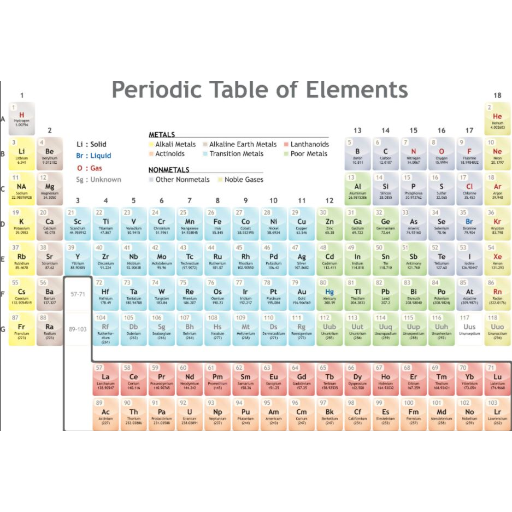
What are Periods and Families?
Families are certain groups of elements that share similar physical traits, and may react similarly to certain chemicals. A family usually contains multiple groups as both terms mean that they share similar traits and depending on the location, they might share the same amount of valence electrons as well.
Periods are horizontal rows across the periodic table, the atomic numbers decrease as you go from left to right. There are 7 periods numbered. Unlike families, elements in the same period aren't that similar. Depending on the number period, you will have that amount of energy shells when creating a Bohr model for a specific element. For example, if you create a Bohr model for Sodium (Na), it would have 3 energy shells because it's in period 3.
What are Protons? - What's their purpose?
Every element has a different amount of protons, which is one subatomic particle that makes up the nucleus. We also know that each element has something called an atomic number, which is one of the major contributing factors in how the periodic table organizes' its elements. The atomic number is determined by the amount of protons that element's atom contains, so for example: sodium has 11 protons, and it is placed right next to magnesium which has 12 protons.

Metals, Non-Metals, and Metalloids
Flip to the next page to read more about them!

Metals, Non Metals, and Metalloids
*You can refer back to the model on the previous page for reference!
As you can see in the model in the previous page, we've got 3 colors labelled. Metals take up a good part of the periodic table, and are labelled in blue. Non metals are founded mostly on the right of the periodic table, and metalloids can be found sandwhiched between the two. A good way to identify the metalloids is looking at the black outline, which is called the 'staircase'. Every element that's touching it in someway is a metalloid. Metals are known for being lusterous (shiny), good conductors, malleable, and usually solid. Non metals are usually not solid, dull, not ductile, and poor conductors. Metalloids are somewhat of a cross in between the two, known for being brittle and semi-good conductors.
Valence Electrons! What Exactly Are They...?
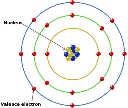
Valence Electrons determine two things for an element- it's group in the periodic table, and the way it reacts to other elements. But what exactly is a Valence Electron? The simple answer is; how many electrons are on the highest energy level in an atom. In other words: how many electrons are on the outermost ring? This determines the reactivity of an element because when exposed to another element, it's outermost shell is what interacts with the other element the most. The first electron orbital needs 2 electrons to be full, the second orbital needs 8, and the third orbital needs 18. Elements in group 1 are considered highly reactive because they need only one more electron to be full.
Valence Electrons! What Exactly Are They...?
So how do groups determine valence electrons, or vice versa? The elements are organized vertically by their valence electrons, these are called groups. Group 1's elements have 1 valence electron, and Group 2's elements have 2. Elements 3-12 depend on the certain element you're looking at. Elements 13-18 can be calculated by subtracting 10 from the group number. Group 17 is also considered highly reactive because they only need one element to have a full ring considering they have 7 valence rings. Group 18 is non reactive because they all have 8 valence electrons, which makes them full and 'not want to look for more electrons.'
Families!
What are the 9 families?
1. Alkali Metals
2. Alkaline Earth Metals
3. Transition Metals
4. Boron Family
5. Carbon Family
6. Nitrogen Family
7. Oxygen Family
8. Halogens
9. Noble Gases
What Do The Families Look Like And Do?
- Alkali Metals are known to be lusterous and highly reactive. They react easily with water, air, and halogens. They're good conductors and mostly ductile.
- Alkali Earth Metals they're reactive, but less reactive than Alkali Metals. They're lusterous and ductile, good conductors too. They're also known to have insoluable compounds in water.
- Transition Metals are lusterous, ductile, high in density, and good conductors. They aren't as reactive and have pretty low reactivity compared to Halogens and Alkali Metals.
- Boron Family has varying reactivity, and boron itself is the only metalloid. Excluding boron, they're metals and have the same similar metal traits. Lusterous and good conductors.
What Do The Families Look Like And Do?
- Carbon Family contains non metals, metals, and metalloids. Therefore the physical properties depend on what element you're looking at. They have 4 valence electrons, and are pretty low when it comes to reactivity.
- Nitrogen Family contains non metals, a metal, and metalloids. Therefore the physical properties depend on the element you're looking at. They also have pretty low reactivity with a valence number of 5 but still vary.
- Oxygen Family has both metals and non metals. Oxygen is one of the most abundant chemicals in Earth's atmosphere. Sulfur has a distinct, rotten egg type smell! They have 6 valence electrons, and the reactivity for each varies.
- Halogens react very easily with Alkali metals and are highly reactive since they only need 1 more electron. They're non metals and exist naturally as compounds.
- Noble Gases are non reactive because they're outermost shell contains 8 electrons, making their shell full. They're all non metals and are gases.
- Full access to our public library
- Save favorite books
- Interact with authors
- < BEGINNING
- END >
-
DOWNLOAD
-
LIKE
-
COMMENT()
-
SHARE
-
SAVE
-
BUY THIS BOOK
(from $3.39+) -
BUY THIS BOOK
(from $3.39+) - DOWNLOAD
- LIKE
- COMMENT ()
- SHARE
- SAVE
- Report
-
BUY
-
LIKE
-
COMMENT()
-
SHARE
- Excessive Violence
- Harassment
- Offensive Pictures
- Spelling & Grammar Errors
- Unfinished
- Other Problem






COMMENTS
Click 'X' to report any negative comments. Thanks!